
AI transforms how images are created to train intelligent systems
- A CITIC researcher from the University of A Coruña, Omar A. Mures, presents pioneering work at SIGGRAPH Asia 2025 on generative AI and semantic segmentation.
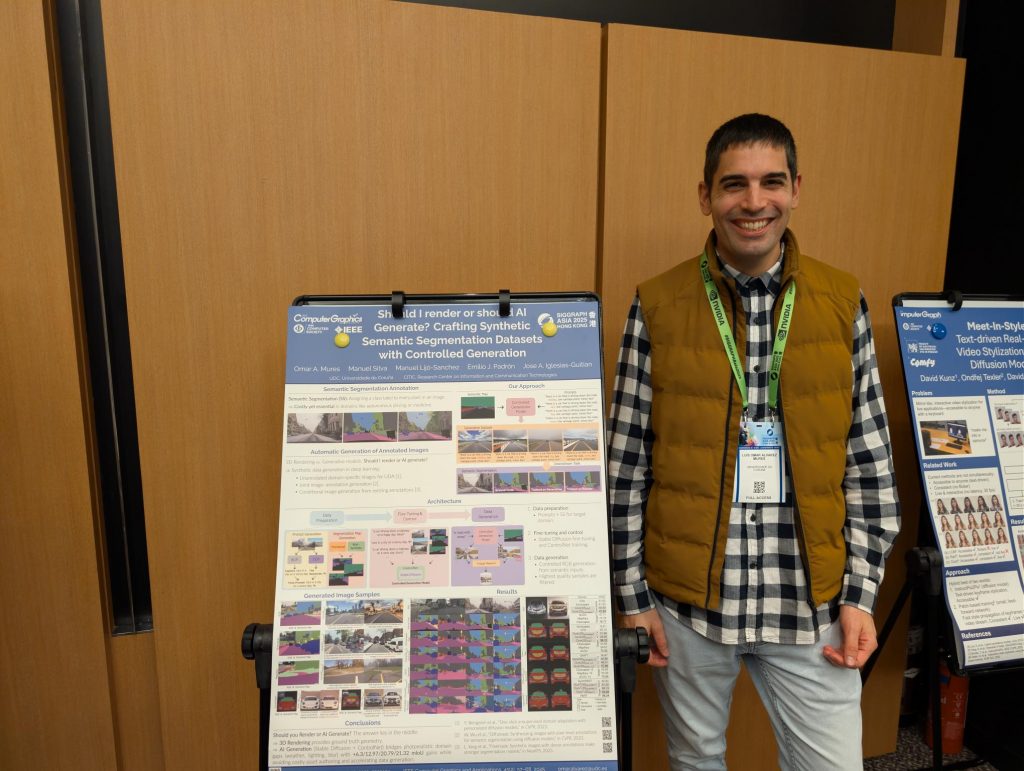
A Coruña, 19 December 2025.- Omar A. Mures, a researcher at the University of A Coruña’s Centre for Research in Information and Communication Technologies (CITIC), took part this week in the international conference SIGGRAPH Asia 2025—one of the world’s leading forums for computer graphics and interactive technologies—held in Hong Kong, where he presented his work “Should I render or should AI Generate? Crafting Synthetic Semantic Segmentation Datasets with Controlled Generation.”
The research was showcased in a workshop organized by the scientific journal IEEE Computer Graphics and Applications, following the publication of the article last spring. As a result of the work’s quality and impact, the journal’s editors decided to promote a dedicated workshop within SIGGRAPH Asia, focused on new applications of generative artificial intelligence in computer graphics and computer vision.
The study explores the integration of generative AI models into the automated creation of annotated synthetic images, aimed at training semantic segmentation models—an essential and highly demanding task in computer vision. Traditional synthetic datasets often rely on complex simulations and rendering techniques that, beyond being costly, struggle to faithfully reproduce the diversity and nuances of the real world, such as lighting variations, weather conditions, or fine-grained scene details.
Mures’ proposal introduces the use of controllable diffusion models, capable of generating diverse synthetic images from textual descriptions and visual guides such as semantic masks. This methodology enables the creation of labeled datasets more efficiently and realistically, significantly reducing production costs and improving the performance of models trained on this data.
The validity of the approach is demonstrated across two distinct image segmentation domains, where models trained with AI-generated data outperform those based on traditional graphics simulations. The results point to a paradigm shift in synthetic data generation for computer vision, raising a central question for the future of the field: render, or generate with artificial intelligence? The participation of a CITIC researcher from the University of A Coruña at SIGGRAPH Asia 2025 strengthens the centre’s and the University of A Coruña’s international visibility in artificial intelligence, computer graphics, and computer vision, as well as its commitment to cutting-edge research and knowledge transfer.