The brain inspires the next generation of sustainable AI at the CITIC of the UDC
- The conference of Teresa Serrano Gotarredona, director of the Institute of Microelectronics of Seville, highlighted the scientific challenges and technological opportunities of neuromorphic engineering.
- The talk was part of the conference cycle “Convergencia Verde: IA para un futuro sostenible” promoted by the Inditex-UDC Chair in Green Algorithms.
A Coruña, March 3rd, 2026
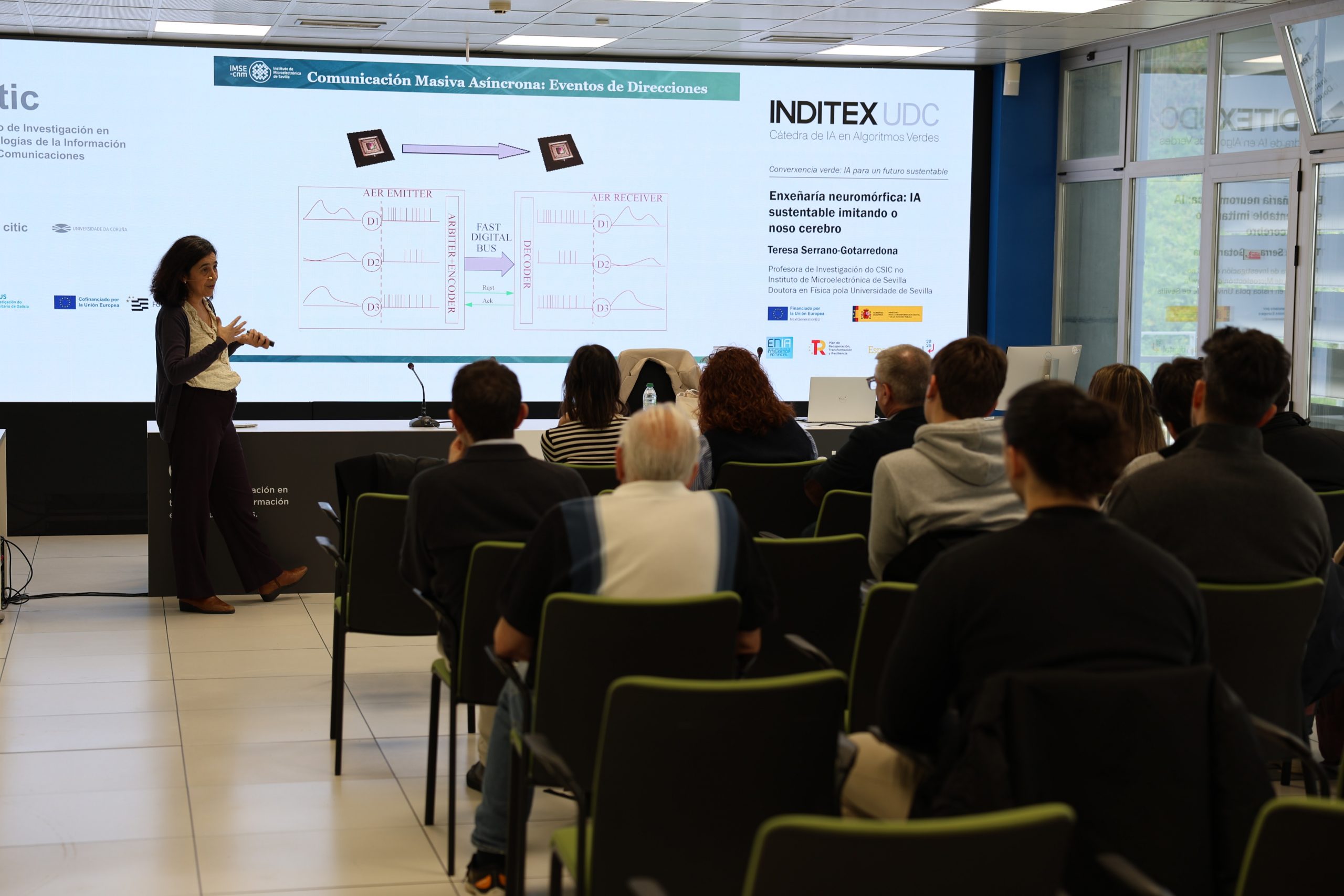
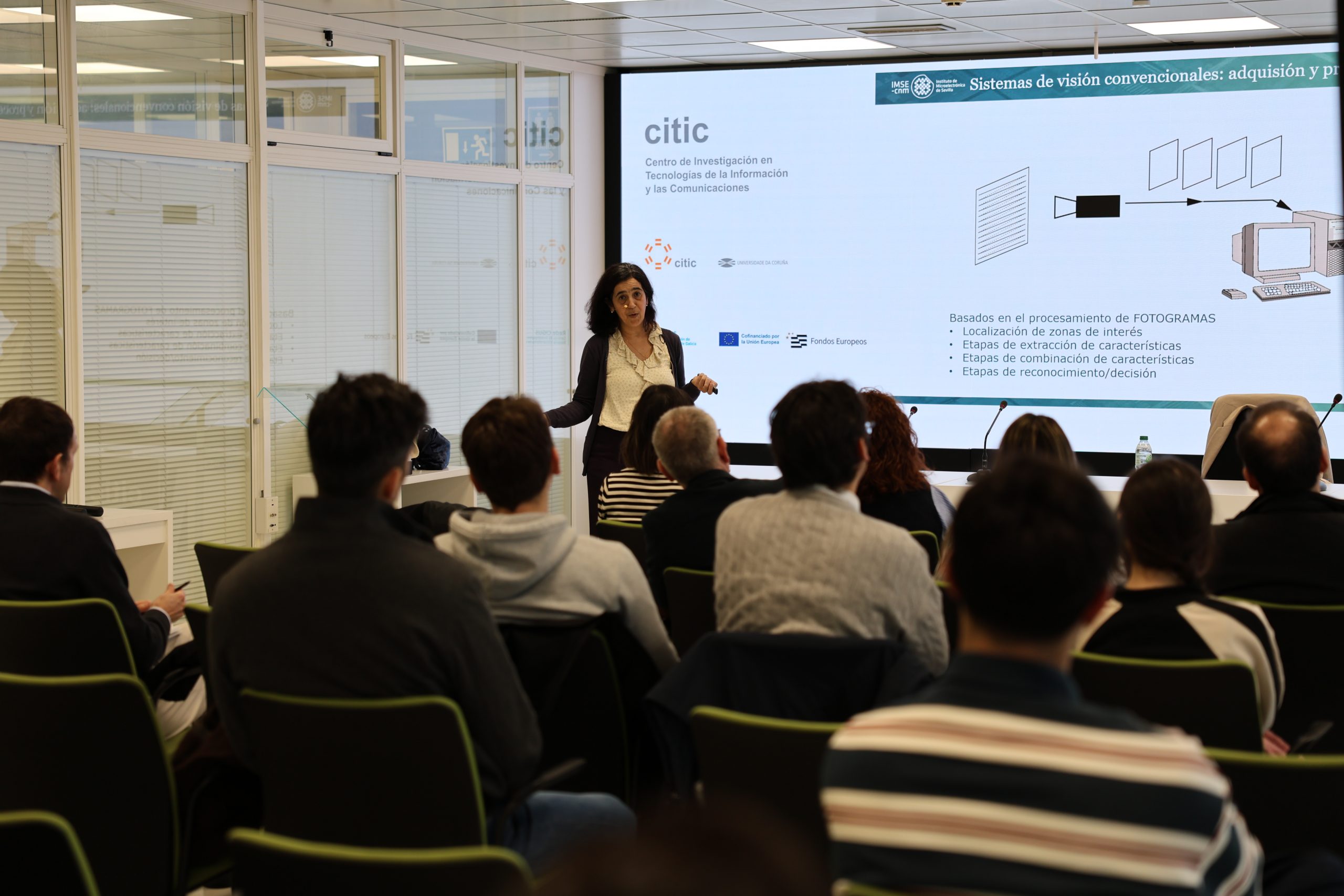
The Information and Communication Technologies Research Centre (CITIC) at the Universidade da Coruña, a centre within the Galician Regional Government’s CIGUS Network, hosted a lecture on Monday by Teresa Serrano-Gotarredona, director of the Institute of Microelectronics of Seville, who delved into neuromorphic engineering’s potential as the foundation for a more sustainable, faster, and more efficient artificial intelligence.
The CSIC researcher participated in the conference cycle “Convergencia Verde: IA para un future sostenible”, organized by the Inditex-UDC Chair of AI in Green Algorithms. Serrano-Gotarredona spoke about neuromorphic engineering and its role as the foundation for a more sustainable, efficient artificial intelligence that closely resembles the functioning of the human brain; furthermore, she provided an explanation with practical applications the research work carried out by her team.
The session allowed for a deep exploration of the most relevant conclusions reached within the emergent field, which proposes a paradigm shift against traditional machine learning. While the dominant focus in AI is supported on technologies and algorithms based on signal acquisition and processing through periodic sampling, neuromorphic engineering is directly inspired by biological systems.
In this regard, it was emphasised that conventional systems operate synchronously and sequentially, while the brain acquires and processes information asynchronously, communicating through electrical impulses. This structural difference necessitates a redesign of both hardware and computational models, incorporating architectures capable of working with real-time events instead of discretised data at fixed intervals.
One of the main challenges is the integration of the time variable into neuromorphic models. Its incorporation opens up enormous potential by allowing the exploitation of space-time correlations within the data, akin to the case of sensory processing. However, it also introduces a greater complexity in the development of mathematical models, learning systems and physical implementations. Designing algorithms capable of learning through continuous fluxes of events continues to be one of the main scientific challenges of the sector.
Faced with these challenges, neuromorphic engineering offers high-impact opportunities. In the field of sensory processing, it stands out for its high data parallelism and ability to eliminate redundancies, replicating the brain’s efficiency in filtering irrelevant information and prioritising significant events.
Energy efficiency is another key aspect of this technology. By processing only relevant events and sending compressed information, neuromorphic systems can drastically reduce power consumption. This makes them ideal solutions for autonomous systems in IoT environments or smart surveillance devices, as well as other applications where autonomy is crucial.
The high speed and low response latency also make this a strategical technology in dynamic environments, such as advanced robotics, self-driving vehicles guidance, drones or certain industrial applications where real-time reaction capacity is critical.
Furthermore, the asynchronous and continuous processing allows the preservation of the temporal structure of data, facilitating the natural recognition of dynamic scenes and the efficient implementation of recurrent neural networks. This feature brings artificial systems closer to the way the brain processes changing information in real-world environments.
Finally, the conference placed the focus on the interdisciplinary dimension of neuromorphic engineering, which builds bridges between electronics, artificial intelligence and neuroscience, and could have interesting applications in the field of medicine.
About the CITIC
The CITIC is an investigation centre that boosts progress and excellency at R&D&I applied to ICT, created in 2008 by the Universidade da Coruña (UDC). The scientific activity is structured around four main areas of research: Artificial Intelligence, Data Science and Engineering; High-Performance Computing; and Smart Services and Networks, as well as a research area transversal to all others: Cybersecurity.
The CITIC is credited as a Centre of Excellence and a member of the CIGUS Network for the 2024-2027 period, which guarantees the quality and impact of its research. The endorsement, structure and improvement of the CITIC is cofinanced by the Xunta de Galicia and 60% by the European Union within the framework of the Operative Program FEDER Galicia 2021-2027, with the goal of promoting “a more intelligent Europe: An innovative and intelligent economic transformation” (ED431G 2023/01).