
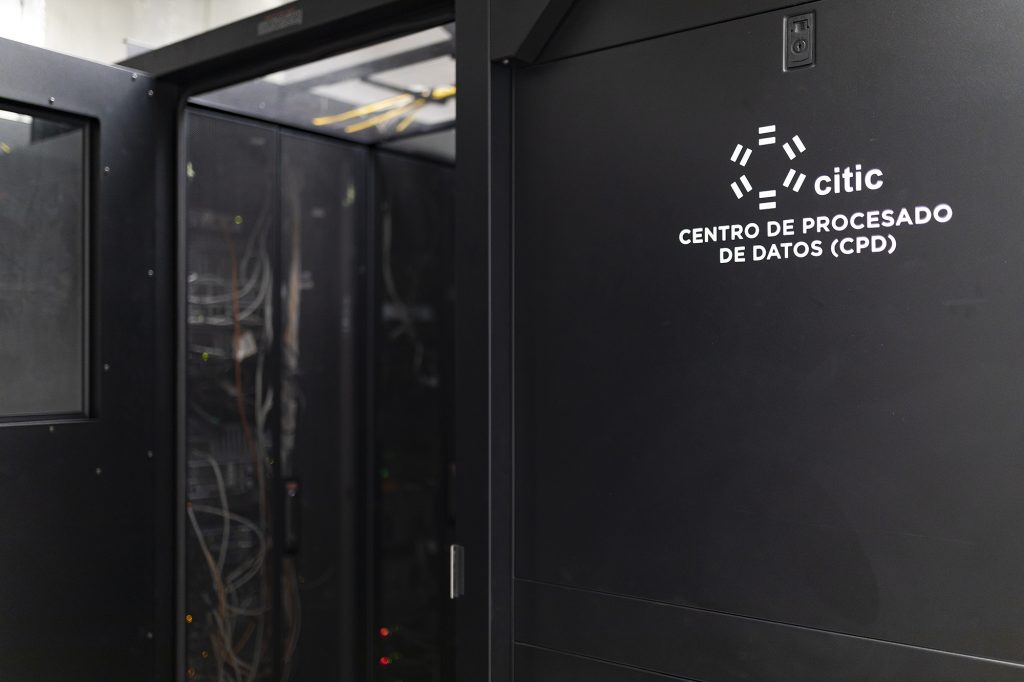
The CITIC at the UDC is driving forward a pioneering quantum infrastructure to support research
- The centre has secured a grant of 1.04 million euros to create a new infrastructure for the development of projects that will have an impact in areas such as health, industry and cybersecurity.
- The award of this grant recognises CITIC’s established track record in the field of quantum computing, an area in which the centre has been a pioneer in Galicia alongside CESGA, and in which it has carried out sustained scientific activity with a growing profile both nationally and internationally.
A Coruña, May 4th, 2026
The Universidade da Coruña has taken an important step towards the future of technology after securing a grant of 1.041.161,15 euros aimed at bolstering research into quantum computing and communications at the Centre for Research in Information and Communication Technologies (CITIC). This funding, awarded under a national call for proposals launched by the Ministry of Science, Innovation and Universities and the State Research Agency, and co-funded by the European Union, will enable the centre to develop new scientific capabilities in a field considered key to technological development in the coming decades.
The investment will enable the creation of an advanced infrastructure that combines classical computing technologies with quantum systems, an approach that opens up new possibilities for tackling complex problems that are currently difficult or even impossible to solve. Quantum computing allows information to be processed in a radically different way to current methods, which could lead to significant advances in fields such as medicine, digital security and the design of new materials.
Thanks to this project, the CITIC will have access to specialised equipment that will enable it to experiment with these types of technologies and develop new applications. Furthermore, the infrastructure is designed to be shared by different research groups, fostering interdisciplinary collaboration and the generation of knowledge with a social impact.
At the same time, the incorporation of these capabilities reinforces the role of the UDC’s CITIC as an agent of innovation and opens the door to new opportunities for collaboration with businesses, facilitating knowledge transfer and contributing to the economic and technological development of the broader community.
Trajectory, positioning and the quantum ecosystem
In this context, CITIC’s involvement in the ITG-UDC Chair in Quantum Technology, recently established between the Universidade da Coruña and the ITG technology centre, reinforces the institution’s dedication to this field, driving forward research, training and knowledge transfer.
The director of CITIC, who will head the ITG-UDC Chair at the university, Manuel G. Penedo, emphasises that “the funding received allows us to move towards more ambitious research and position ourselves at the forefront of the field of quantum technologies. It is an opportunity to grow, collaborate and generate knowledge with a real impact”. In this regard, he emphasises that “the acquisition of this infrastructure is the result of the centre’s sustained track record in this field and a strategy of progressive specialisation”.
The CITIC has carried out in recent years significant scientific activities in the field of quantum computers, in which it has been one of the pioneering centres in Galicia alongside the CESGA. This track record has been reflected in its participation in competitive projects such as NEASQC (Next Applications of Quantum Computing), led in the centre by researcher Vicente Moret Bonillo, as well as its involvement in initiatives such as the QEX project, the first European Centre of Quantum Excellence, in which the Spanish participation is entirely Galician. At the CITIC, QEX is led by Diego Andrade and has a team of research staff based at the centre. These activities reinforce its integration into international networks of excellence in quantum computing.
Additionally, CITIC researcher Diego Andrade has been appointed this year as co-leader of the Quantum Computing working group of the European Technology Platform for High Performance Computing (ETP4HPC), the platform that establishes the technological roadmap on the subject of supercomputing in Europe. This consolidates the centre’s presence among the leading European forums on high-performance computing and quantum technologies.
This set of initiatives represents explicit recognition of a proven track record and equipment that few organisations and research centres currently possess, placing the CITIC in a prominent position in applied quantum technologies development.
Securing this support marks a new step in the centre’s strategy to establish itself as a key player in quantum computing research in Galicia, with a particular focus on areas such as cryptography and secure communications. This development falls within a line of work aimed at applying these technologies to problems with a real social impact.
In line with this, Jerónimo Puertas, Vice-Rector for Research and Knowledge Transfer at the UDC, emphasises that “this is a strategic investment that reinforces our commitment to high-quality research and to the development of technologies that will shape the future. A commitment to science is also a commitment to the progress of society”.
An open and collaborative infrastructure
The infrastructure is designed to serve a broad research community. Groups from various disciplines within the Universidade da Coruña, ranging from engineering or computer science to the medical sciences, as well as external entities such as research centres or businesses interested in exploring the potential of these tools, will all be able to benefit from it. In this way, an open environment that fosters collaboration and facilitates the faster transfer of scientific advances to society is created.
The project will also involve research staff from CITIC itself, who will help to clearly convey the potential of these technologies. Eduardo Mosqueira Rey, deputy director of CITIC and a researcher at the centre specialising in the field, explains: “Quantum computing is becoming increasingly part of our daily lives. In the not-too-distant future, it will allow us to solve complex problems more quickly and with greater precision, which could have a direct impact on many areas, from healthcare to industry”.
Álvaro Leitao Rodríguez, a Ramón y Cajal researcher working on the application of quantum computing to the financial sector, points out that “the new infrastructure will allow us to study the potential theoretical quantum advantages in an environment much closer to reality, and to assess which methodological and/or technical aspects are relevant for translating these computational advantages into the resolution of complex practical problems”.
Three main areas of development
The new infrastructure will be organised into three main areas that complement one another. Firstly, it will enable experimentation with quantum computing through specific systems that reproduce the behaviour of these environments in a controlled manner. Secondly, it will incorporate capabilities in quantum communications, a key technology for ensuring far more secure information transmissions. Finally, all of this will be integrated with existing high-performance computing systems, enabling a combination of the best of classical and quantum computing to tackle complex problems more efficiently.
About the CITIC
The CITIC is an investigation centre that boosts progress and excellency at R&D&I applied to ICT, created in 2008 by the Universidade da Coruña (UDC). The scientific activity is structured around four main areas of research: Artificial Intelligence, Data Science and Engineering; High-Performance Computing; and Smart Services and Networks, as well as a research area transversal to all others: Cybersecurity.
The CITIC is credited as a Centre of Excellence and a member of the CIGUS Network for the 2024-2027 period, which guarantees the quality and impact of its research. The endorsement, structure and improvement of the CITIC is cofinanced by the Xunta de Galicia and 60% by the European Union within the framework of the Operative Program FEDER Galicia 2021-2027, with the goal of promoting “a more intelligent Europe: An innovative and intelligent economic transformation” (ED431G 2023/01).