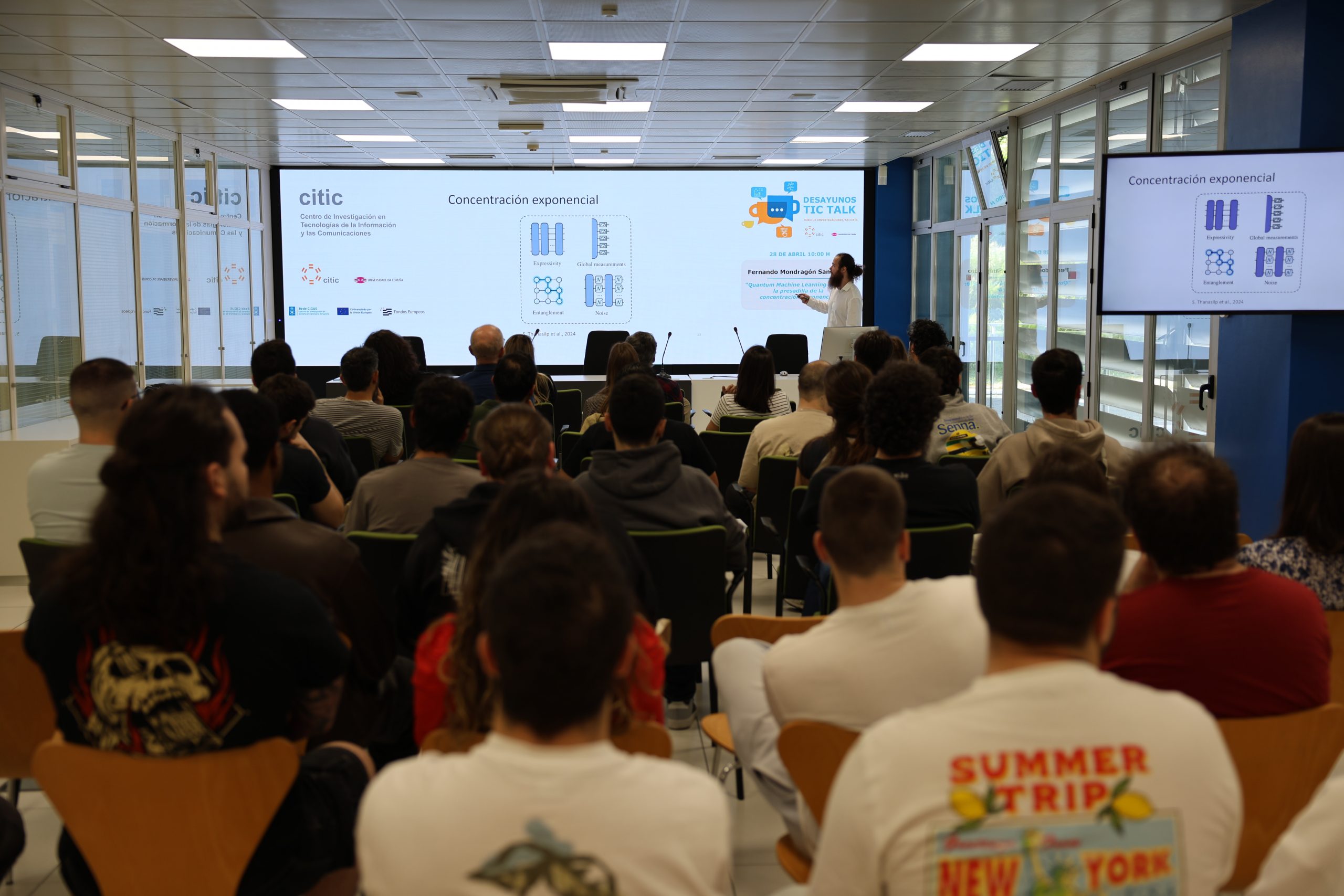
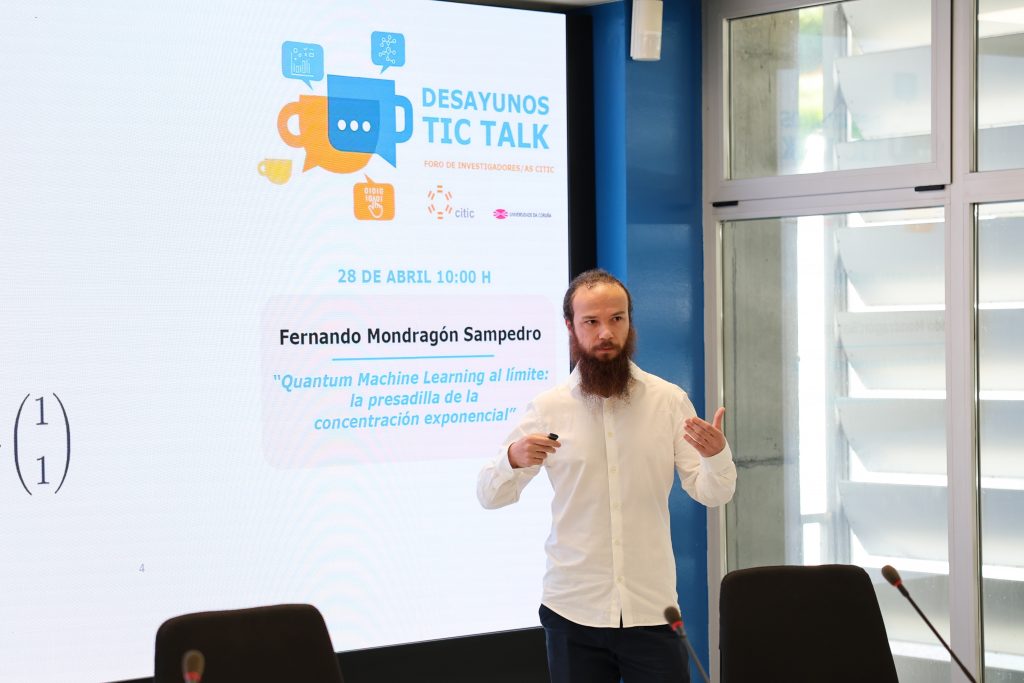
The TIC Talk Breakfast of April will address the limits of Quantum Machine Learning and the challenge posed by exponential concentration
A Coruña, April 28th, 2026
The UDC CITIC’s April ICT Talk Breakfast featured Fernando Mondragón Sampedro, who gave a talk entitled “Quantum Machine Learning at the limit: the nightmare of exponential concentration”, focusing on one of the main current challenges facing quantum computing applied to machine learning.
During the session, the speaker delved into the phenomenon of exponential concentration, a behaviour that emerges as the number of qubits in quantum machine learning models increases. This phenomenon causes the values measured in quantum systems to cluster around a specific value, which means the circuits must be run an exponential number of times to achieve accurate results. Otherwise, the measurements may prove unreliable or even random.
Mondragón explained that this characteristic poses a serious scalability problem, as the exponential growth in the number of runs implies an equally exponential increase in computational resources, both in terms of time and infrastructure. In practice, this limits the feasibility of tackling complex problems that require a large number of qubits.
In the experimental plane, the talk presented results obtained from three different models: the fidelity kernel, the projected quantum kernel and quantum extreme learning. As explained, all of these can be affected by exponential concentration, albeit for different reasons. A comparative analysis of their behaviour makes it possible to identify which approaches may be most suitable depending on the type of problem.
The use of the scaling factor, or quantum bandwidth, was also discussed; a technique that allows one of the sources of the phenomenon to be partially mitigated. Although so far its experimental application has focused only on the fidelity kernel, its flexible nature opens the door to its use in other models.
In conclusion, the speaker highlighted that exponential concentration represents one of the major challenges to overcome for the development of large-scale quantum machine learning. However, the results presented provide useful tools for detecting its presence and guiding future research, whether to minimise its impact or to anticipate the resources required in specific scenarios.