
A thesis from CITENI at the University of A Coruña demonstrates the viability of electrical curing of composites as an efficient alternative to autoclave
- Research carried out by CITENI puts forward the use of electric currents -based on the Joule effect- as an alternative to conventional curing of carbon fibre composites.
- The research, which gave birth to a doctoral thesis, enables a reduction in energy consumption and processing times without compromising the mechanical performance of the components, and opens up new possibilities for their application in industrial settings.
- The thesis was co-directed by Salvador Naya, researcher at CITIC, and Ramón Artiaga, from CITENI
A Coruña, May 8th, 2026
Research carried out by the Centre for Research into Naval and Industrial Technologies (CITENI), located at the Ferrol Industrial Campus of the Universidade da Coruña, proposes an alternative to the traditional process for manufacturing carbon fibre composites based on the use of electricity.
The research focuses on what is known as “composite curing”, a key stage in which liquid resin is hardened using heat and pressure to form a solid, resistant component. This process is usually carried out in furnaces or autoclaves, which are expensive and energy-intensive pieces of equipment.
Against this backdrop, the doctoral thesis by researcher Laura Sabela Vázquez, entitled “Industrial scaling and improvement of energy efficiency in the curing of composites by electric current”, proposes replacing these systems with a method based on the Joule effect, in which electric current generates heat directly within the material tnahks to the conductivity of the carbon fibres. This approach allows for the shortening of manufacturing times and a reduction in energy consumption.
Developed within the Thermal and Rheological Properties of Materials (PROTERM for its name in Spanish) research group, the thesis was co-directed by CITENI researcher Ramón Artiaga and CITIC researcher Salvador Naya, and analyses the feasibility of the process from both a technical and industrial perspective.
Electricity as an alternative to autoclave
The research explores the use of electrical resistance heating — the Joule effect — as a curing mechanism, exploiting the inherent conductivity of carbon fibres to generate heat internally using continuous current. Compared to conventional methods, which require large infrastructures and lengthy processing cycles, this system enables the development of solutions that are more compact, efficient and adaptable to different industrial environments.
The results, obtained using techniques such as dynamic mechanical analysis (DMA)—which assesses the material’s response to stress and temperature changes—and differential scanning calorimetry (DSC)—which studies heat exchanges during curing—show that the electrical process achieves quality levels equivalent to those of traditional methods, both in terms of the degree of curing and thermal stability. Furthermore, a significant reduction in processing time and energy consumption has been recorded.
The study also incorporates advanced statistical analysis using generalised additive models (GAM), which enables the influence of manufacturing variables on the final behaviour of the material to be identified. In addition, fatigue tests, which simulate conditions of repeated use, indicate that electrically cured parts (particularly those with prior vacuum compaction) can match and even surpass the performance of those cured in a furnace.
Towards industrial application
Overall, the results make this technology a promising alternative for faster, more efficient and more sustainable manufacturing, with particular relevance to structural applications and ‘in situ’ repair scenarios.
Beyond experimental validation, the thesis addresses the challenge of scaling the process up to industrial levels, for which it identifies the critical design variables and operating conditions required to implement it in real production environments, thereby reinforcing its transfer potential to the industrial sector.
The study concludes that Joule heating not only noticeably improves energy efficiency, but also broadens the technological possibilities in the advanced manufacture of composite materials.
Thesis defence and academic recognition
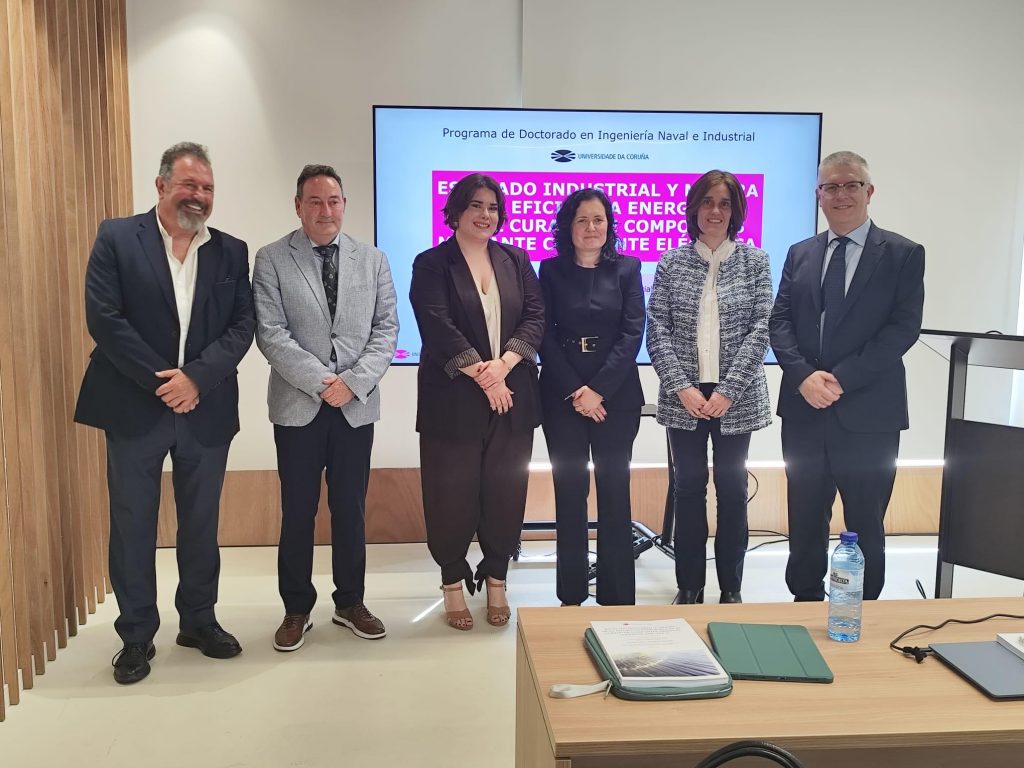
The thesis defence took place this past April 24th at the Batallones Building on the Ferrol Industrial Campus in front of an examination board chaired by Fancisco Corpas (from the Universidad de Jaén), with Ana Isabel Ares (Universidade da Coruña) acting as secretary and Silvia Gómez (Universidade de Vigo) as a member.
The thesis was awarded with an “Outstanding” grade, equivalent to an A+, and recommended fore the “cum laude” distinction, in recognition of its scientific rigour and its applicability in the industrial sector.
Impactful research from the Ferrol Industrial Campus
This thesis forms part of the strategic research lines being developed at CITENI in the fields of composite materials, energy efficiency and advanced manufacturing. The work reinforces the role of the Ferrol Industrial Campus as an ecosystem for applied research, focused on developing innovative technological solutions that address the current challenges faced by the industry, combining sustainability, efficiency and knowledge transfer.