
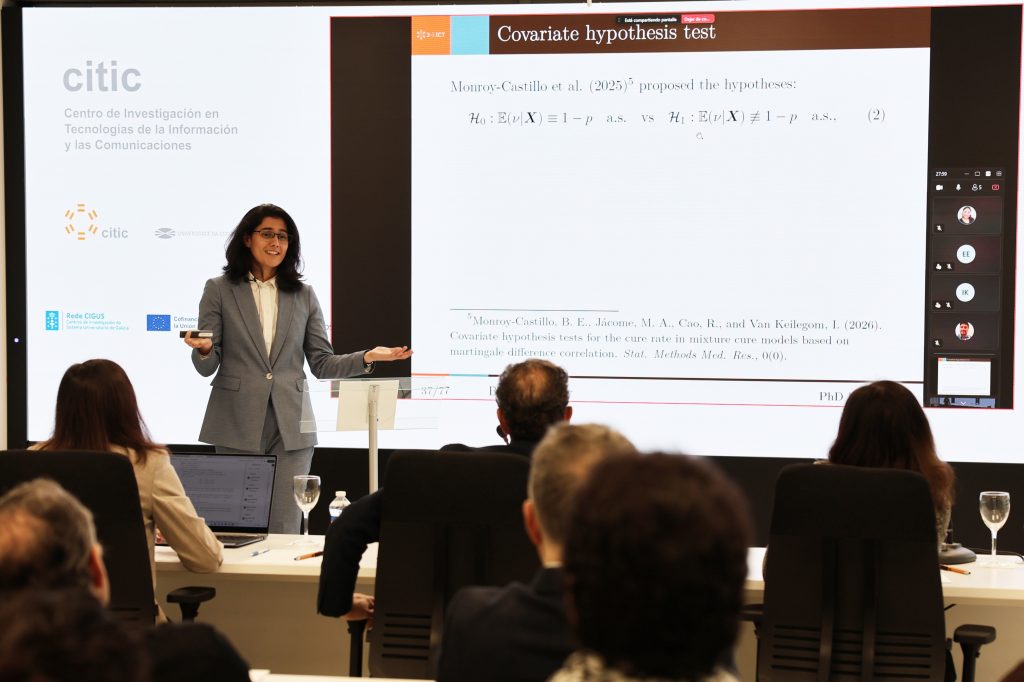
Blanca Monroy, MSCA-COFUND researcher, presents her thesis regarding new statistical models used to predict rheumatoid arthritis remission
A Coruña, April 13th, 2026
The SCA-COFUND researcher Blanca Monroy Castillo has recently defended her doctoral thesis entitled “Flexible Cure Models in Data Science for Predicting Sustained Remission in Rheumatoid Arthritis”, carried out under the supervision of Ricardo Cao Abad and María Amalia Jácome Pumar of the UDC’s CITIC, and Francisco J. Blanco García of the CICA.
This work represents a significant advance in the field of survival analysis, as it incorporates innovative tools for studying long-term clinical outcomes, particularly in contexts where some patients may not go on to develop the disease or the worsening of the condition under investigation. These situations, which are common in chronic conditions such as rheumatoid arthritis, are addressed using mixed-effects cure models that distinguish between susceptible individuals and those in long-term remission.
Starting from this approach, the research provides new statistical tools to better understand which factors influence the probability of recovery in patients with chronic diseases. Among the main findings is a comparative study of different methods for measuring relationships between variables, resulting in an improved version that is more stable and reliable, particularly when working with small or medium-sized datasets.
Furthermore, the study proposes four new statistical tests that enable the analysis of whether certain variables influence healing rates. Three of these tests are based on an advanced technique capable of detecting complex and non-linear relationships between variables. Studies carried out using simulations show that these methods work correctly and offer better results than other existing alternatives in various situations.
To facilitate their use by other researchers, all the methodologies developed have been implemented in an R package called MDCcure, which allows these techniques to be applied in a user-friendly manner in survival analysis.
Finally, the work was validated using real-world data from patients with rheumatoid arthritis. In this case, the proposed methods enable the identification of factors associated with a higher probability of sustained remission, which may be useful for improving clinical decision-making and moving towards more personalised treatments.