
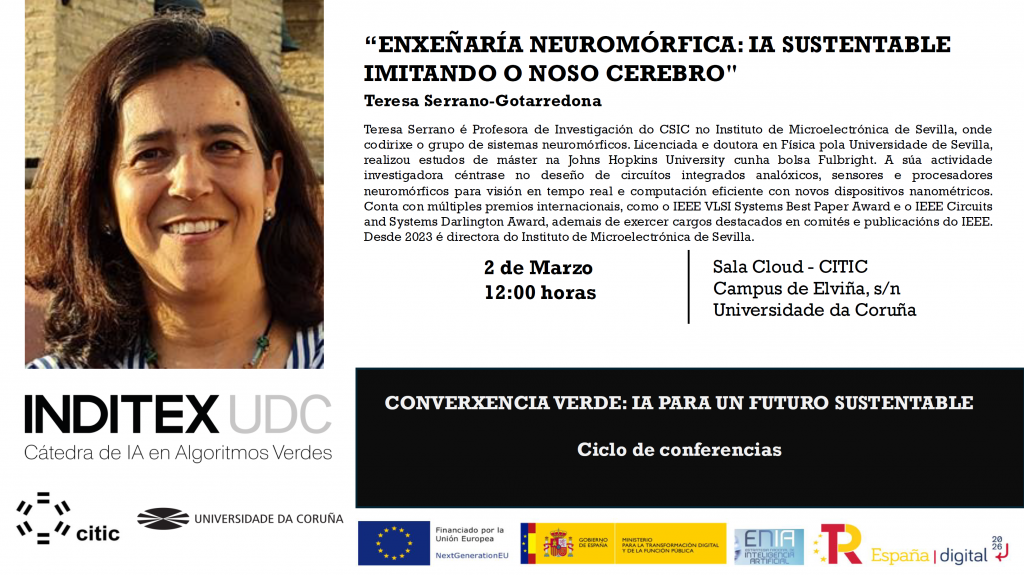
The director of the Institute of Microelectronics of Seville will speak at the CITIC of the UDC about neuromorphic engineering and sustainable AI inspired by the human brain
- Teresa Serrano-Gotarredona, researcher at the CSIC, will give nex Monday, March 2nd, a conference at the CITIC within the seminar “Convergencia Verde: IA para un futuro sostenible” promoted by the Inditex-UDC Chair in Green Algorithms
A Coruña, February 25th, 2026
Teresa Serrano-Gotarredonda, research teacher at the CSIC at the Institute of Microelectronics of Seville and director of the Centre since 2023, will give a conference about “Neuromorphic Engineering: Sustainable AI imitating our brain” next Monday, March 2nd. The talk will take place at 12:00 at the Cloud Room of the CITIC, in the Elviña Campus of the Universidade da Coruña as a part of the conference cycle “Convergencia verde: IA para un future sostenible”, promoted by the Inditex-UDC Chair in Green Algorithms. The conference will be open to anyone until a full quorum is reached by registering at this link.
Neuromorphic engineering is centred around emulating the computational principles and architectures of biological brains to design sensors and processors capable of carrying out cognitive tasks, such as visual or auditory processing, improving the efficiency over conventional implementations. During the conference Serrano-Gotrarredona will explain the differences between biological neuronal systems and artificial computing systems, both on an architectural level and regarding codifying and processing information. One of the main subjects will be showing how our sensors can capture what we see and transform it into electric signals that a brain or a computer can understand. The way these signals travel and are processed in a more flexible and efficient way, without having to do everything at the same time, will also be explained. Furthermore, she will showcase real examples of sensors and computers inspired by the human brain, created by the Institute of Microelectronics of Seville, which will allow for machines to capture and process visual information in a more intelligent way.
International expert
With a degree and a PhD in Physics by the Universidad de Sevilla, Teresa Serrano-Gotarredona completed her master’s degree at John Hopkins University through a Fulbright grant. Her investigation is focused on the design of integrated analogical circuits, sensors and neuromorphic processors for real time vision and efficient computation through the usage of devices on a nanometric scale. Throughout her career, she has been acknowledged internationally with awards such as the IEEE VLSI Systems Best Paper Award and the IEEE Circuits and Systems Darlington Award, besides also occupying relevant positions in committees and publications of the IEEE.
About the Chair
The Inditex-UDC Chair in AI in Green Algorithms, created in 2023 by the Universidade da Coruña and Inditex, has as its main mission to boost research, education and knowledge transfer on the field of artificial intelligence applied to sustainability. Among its goals are especially noticeable the development of formative programs, the boost and fostering of innovation and public-private collaboration, the valuation of research results and scientific dissemination. It has competitive public funding from the Ministry of Digital Transformation and Public Administration, through the ENIA Chair Grants, with European funds from the Spanish Government’s Recovery, Transformation and Resilience Plan, and also private funding from the Inditex Group. The chair is based on the UDC’s solid track record in AI, established since the late 1980s and strengthened with the creation of CITIC, and on Inditex’s commitment to innovation and sustainability, highlighting its environmental objectives towards net-zero emissions by 2040.
About the CITIC
The CITIC is an investigation centre that boosts progress and excellency at R&D&I applied to ICT, created in 2008 by the Universidade da Coruña (UDC). The scientific activity is structured around four main areas of research: Artificial Intelligence, Data Science and Engineering; High-Performance Computing; and Smart Services and Networks, as well as a research area transversal to all others: Cybersecurity.
The CITIC is credited as a Centre of Excellence and a member of the CIGUS Network for the 2024-2027 period, which guarantees the quality and impact of its research. The endorsement, structure and improvement of the CITIC is cofinanced by the Xunta de Galicia and 60% by the European Union within the framework of the Operative Program FEDER Galicia 2021-2027, with the goal of promoting “a more intelligent Europe: An innovative and intelligent economic transformation” (ED431G 2023/01).