The TIC Talk Breakfasts analyse how astrocytes, the hidden “stars” of the brain, can boost artificial intelligence
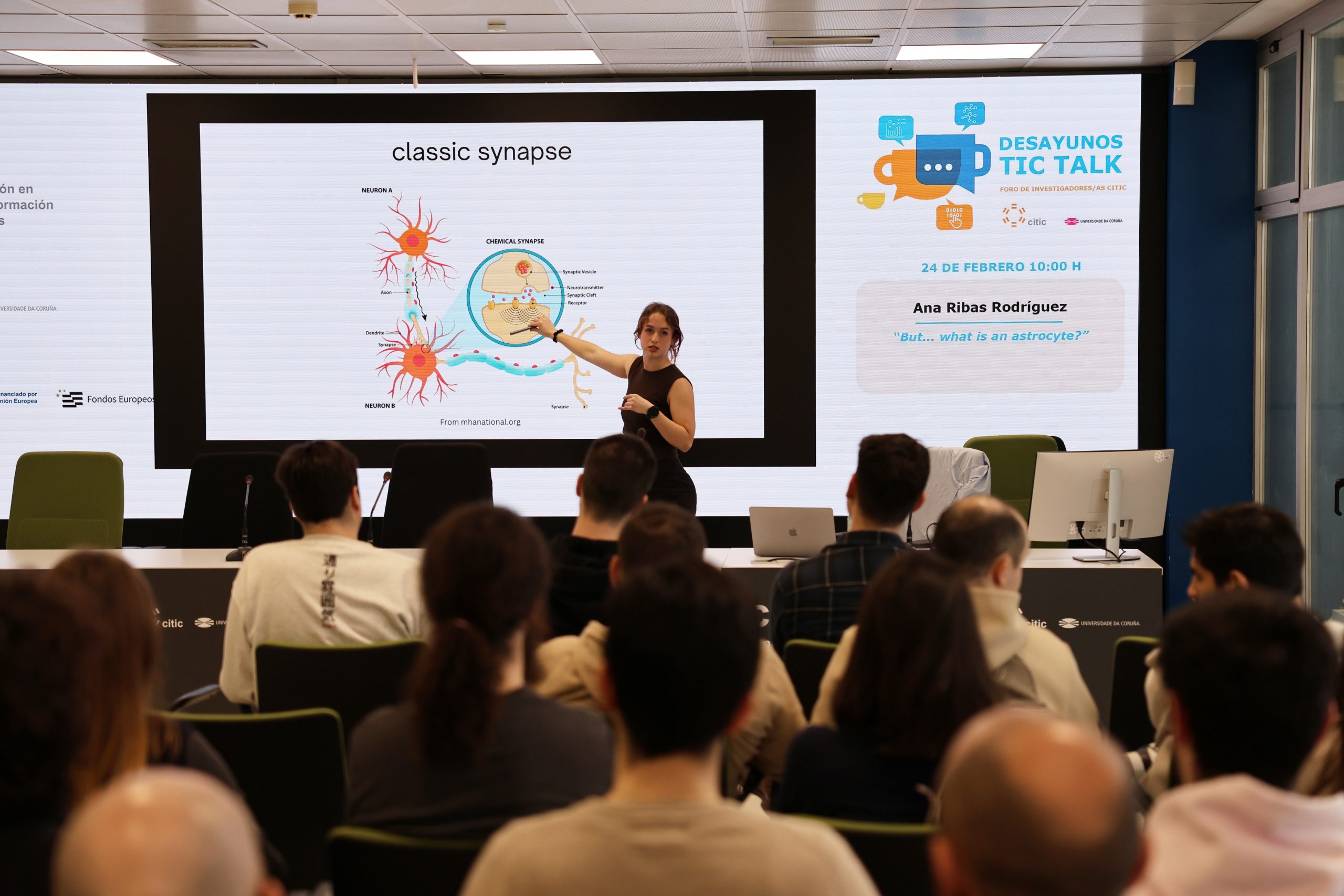
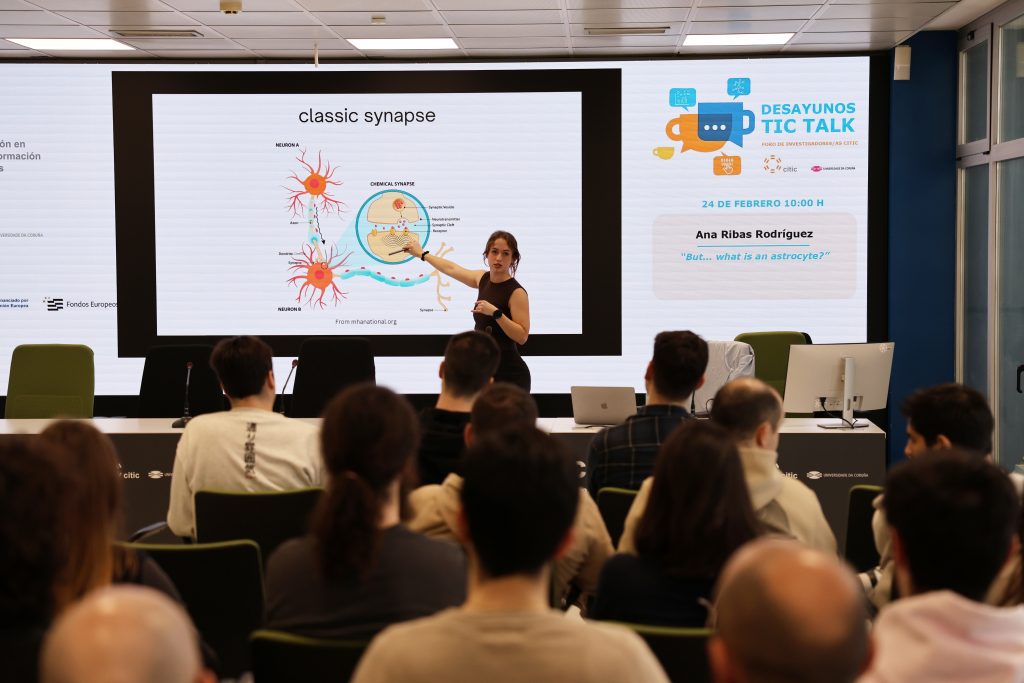
The CITIC at the Universidade da Coruña held this past Tuesday a new edition of the TIC Talk Breakfasts, a space of knowledge dissemination and debate dedicated to technology and innovation. In this occasion, the researcher Ana Ribas was in charge of giving the talk titled “But… what is an astrocyte?”, centred around the connection between neuroscience and artificial intelligence.
Artificial neuron networks were born with the goal of understanding better how the human brain works. Traditionally, research was focused on neurons as the key elements of the nervous system. However, advances in neuroscience demonstrated that they were not the only cells that play a part in information processing.
Astrocytes specifically, braincells that for a long time were considered as simple “helpers” of neurons, in reality have an active role in information processing. Under this model, they are not limited to providing support, but are instead an active participant in neuronal computation: They regulate hot information is transmitted from a neuron that emits the signal (presynaptic) and the neuron that receives it (postsynaptic). By modulating this transmission, they influence directly on the intensity, the rhythm and the efficiency of neuronal communication, thus contributing to the dynamic the brain uses to process information.
Thanks to the inspiration provided by this biological mechanism, more and more researchers are starting to incorporate artificial astrocytes inside deep learning architectures. These mechanisms work as a “fine tuning” system of the artificial brain. Instead of changing the form or the structure of the network, they modify the intensity that the connections between the neurons depending on the activity they have at any given time. This is to say, if certain connections are used more often and give good results, they are reinforced; if they are not useful, they are weakened.
Thanks to this continuous adjustment, the network can constantly adapt to new situations and learn from experience without a need too be redesigned from the inside. It is as if, instead of rebuilding a road, we just regulated traffic so that it flows better.
In different tests and practical applications, this framing has proven that systems become more stable (less likely to fail in case of changes or noise) and more efficient on their performance.
During the talk, Ana Ribas presented the biological role of astrocytes, connected it to the fundamental principles of brain organisations and showcased experimental evidence that illustrated the potential that artificial astrocytes hold in the development of new artificial intelligence solutions.